
A simulation scenario is only as valuable as what happens after it ends. The clinical decisions a learner made, the communication breakdowns the team did not catch, and the near misses that passed without recognition do not become meaningful learning without a structured debrief. That is why debriefing simulation is where experience becomes competence and where the investment in high-fidelity scenarios delivers its greatest value.
For nurse educators and simulation faculty, the challenge is not recognizing the importance of debriefing. Instead, it is creating debrief sessions that are consistently rigorous, psychologically safe, and closely aligned with the learning objectives of every scenario. The following best practices can help simulation programs build a more consistent and effective approach.
1. Standardize on a Single Evidence-Based Debriefing Framework
Several validated frameworks provide faculty with a structured approach to debriefing. The most widely adopted in healthcare simulation are PEARLS, GAS, and advocacy-inquiry, each offering unique strengths depending on the learning objectives and the facilitator’s experience.
The PEARLS framework combines learner self-assessment, guided discussion, and directive teaching, allowing faculty to adapt their facilitation style based on the situation. For example, a straightforward clinical error may require direct instruction, while a communication breakdown involving several team members is often better explored through advocacy-inquiry, which helps uncover the learner’s reasoning rather than assuming it.

The GAS model follows a simple sequence of gather, analyze, and summarize. Other established approaches include TeamGAINS and after-action review. Regardless of the framework chosen, the most successful simulation programs select one approach, train faculty consistently, and build scenario-specific debrief guides around it. Standardization reduces variability between instructors and produces more consistent learning outcomes.
2. Plan Debriefing Simulation Time Before It Begins
One of the most common mistakes in simulation education is treating the debrief as whatever time remains after the scenario. While a commonly cited guideline suggests that debriefs should last roughly twice as long as the simulation itself, current Healthcare Simulation Standards of Best Practice note that there is no fixed ratio. Instead, the appropriate length depends on factors such as scenario complexity, learner experience, the number of objectives, and whether significant performance gaps emerged.
As a practical minimum, the debrief should last at least as long as the simulation itself. Otherwise, learners may not have enough time to move beyond simply recalling events and into meaningful clinical reflection. Building dedicated debrief time into the schedule from the outset ensures that reflection is never treated as an afterthought.
3. Use Video to Support the Conversation, Not Replace It
Video review is most effective when it reinforces a structured discussion rather than becoming the discussion itself. Research has shown that video-assisted debriefing can improve learner engagement, performance, and self-reflection when it is paired with experienced facilitators and an evidence-based framework. Watching specific moments from the scenario allows learners to examine what actually occurred rather than relying on memory alone.
Timestamped annotation makes this process even more efficient. Faculty can flag key decision points during the simulation and immediately return to those moments during the debrief. LearningSpace supports this workflow by allowing instructors to annotate live scenarios and retrieve those clips without additional editing.
At the same time, video should remain a supporting tool. Reviewing a few carefully selected moments typically leads to stronger learning than replaying lengthy portions of the simulation without a clear instructional purpose.
4. Facilitate Reflection Instead of Delivering a Lecture
Even the best debriefing framework depends on effective facilitation. Research consistently shows that learners gain more from debriefs when facilitators guide reflective conversations rather than dominate them. Faculty who ask thoughtful questions, encourage learners to explain their reasoning, and create psychologically safe discussions consistently achieve stronger educational outcomes.
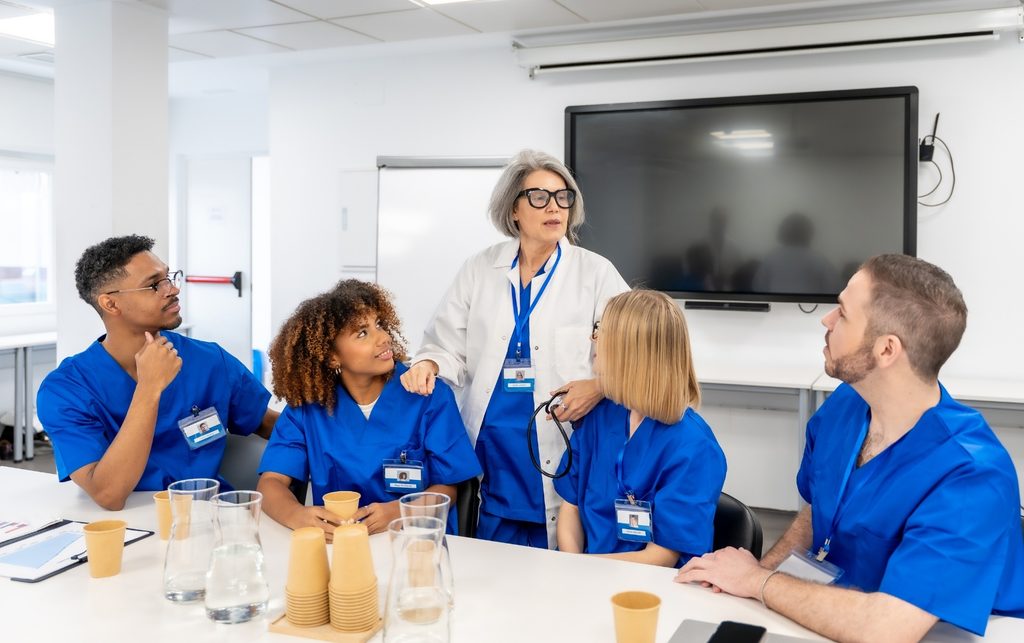
Faculty development is equally important. Programs that invest in facilitator training, structured observation, and peer review create greater consistency across instructor teams. As a result, learners receive a more reliable educational experience regardless of who leads the simulation.
5. Build Debriefing Simulation Into a Repeatable Program Workflow
Evidence-based debriefing has four defining characteristics. It is structured, learner-centered, documented, and repeatable. The strongest programs use a consistent framework across all faculty, encourage learners to analyze their own clinical reasoning, and record performance observations that contribute to each learner’s ongoing competency profile. Equally important, they ensure that high-quality debriefing does not depend solely on the experience of a few senior educators.
This is where technology can strengthen consistency. LearningSpace supports recorded scenarios, timestamped annotations, structured debrief tools, and longitudinal learner documentation, helping simulation centers standardize debriefing across instructors, cohorts, and locations.
For Elevate Healthcare (formerly CAE Healthcare), the goal is to make evidence-based debriefing a repeatable program standard rather than a skill limited to individual faculty members. Simulation center directors and nurse educators interested in strengthening their debriefing process can connect with a simulation specialist to learn how LearningSpace supports structured debriefing at scale.
Written in partnership with Tom White